MONUMENT 2017
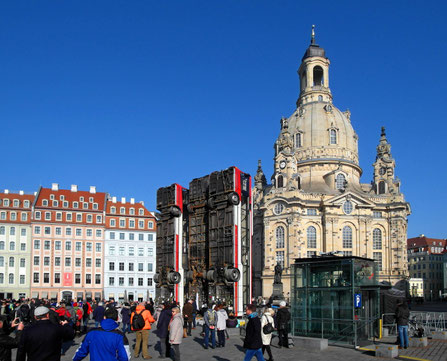
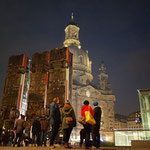
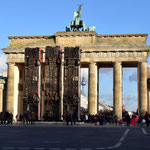
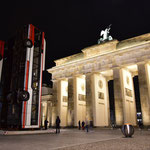
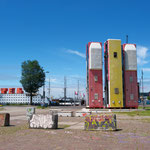
Monument reconfigures an image from the Syrian civil war, improvised barricades made of upright buses in Aleppo into a sculptural intervention in Dresden. By relocating this image into a European urban context, the work collapses the distance between “here” and “elsewhere,” confronting viewers with the mediated nature of conflict.
The installation operates as both memorial and disruption. It exposes how images of war circulate globally while remaining psychologically distant, and challenges the selective mechanisms through which societies acknowledge or ignore violence. In doing so, Monument transforms public space into a site of contested memory and political reflection.
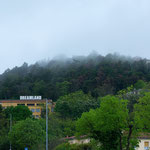
DREAMLAND 2023
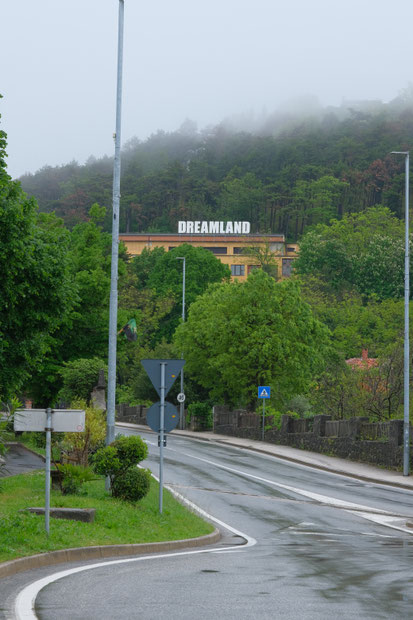
Dreamland emerges from an encounter between personal memory and a historically layered landscape. During his first visit to Istria, Halbouni experienced a sense of familiarity that echoed the coastal environments of his Syrian homeland. This recognition, however, is not presented as a stable truth, but as a constructed perception, shaped by memory and projection.
Developed in the context of the Industrial Biennale, the work is grounded in research into Istria’s complex history as a region defined by continuous movement, cultural exchange, and shifting political frameworks. Rather than treating this history as a fixed narrative, Halbouni approaches it as a dynamic process one that reveals how places are repeatedly redefined through changing perspectives and desires. Installed on the roof of the historic cinema in Labin, Dreamland draws on the symbolic function of the cinema as a site of projection and escapism. The work connects the mechanisms of film, where realities are constructed and consumed, to contemporary forms of tourism and longing. Istria appears as a “dreamland,” a space onto which external desires are projected, promising escape, authenticity, or belonging. At the same time, the installation raises a critical question: for whom does this projection hold true? By juxtaposing personal experience, historical research, and the site-specific context, Dreamland exposes how notions of home, paradise, and elsewhere are produced through overlapping narratives. The work ultimately reveals belonging not as a fixed condition, but as a Fragile construct shaped by perception, mediation, and position.
MOBILISTAN 2022
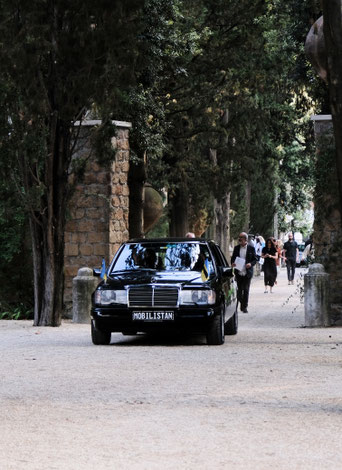
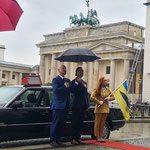
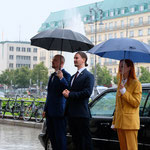
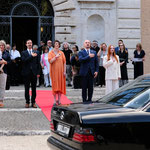
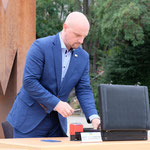
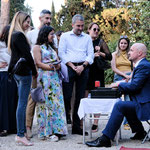
Manaf Halbouni and Christian Manss
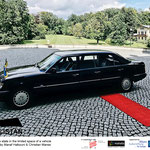
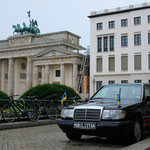
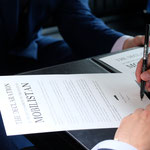
declare the first mobile state in the limited space of
a vehicle in 2021. The art project starts its first
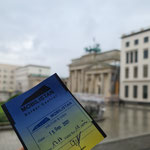
business trip on September 15th at Pariser Platz in Berlin and leads to the Mahalla Festival in Istanbul in the week of September 24rd to October 1st.
What is a state? What is its
territory? Do we accept the way they are defined? Who will
need to recognize us, besides us ourselves? These are
questions that keep reappearing in history. A case in point is the Turkish Republic of Northern Cyprus, a de facto state in the north of the island of Cyprus that is not recognized by the international community except for Turkey – but the state does in fact exist. And it is not the only one of its kind: There are South Ossetia, Abkhazia, Artsakh or Transnistria, to name but a few. And, as an example from the realm of art: there is the art collective NSK (Neue Slowenische Kunst) that in 1992 declared their transformation from a collective into a state ("State in Time"). All examples show that to create facts, a declaration of sovereignty as a state is often sufficient, acceptance by some majority is not mandatory. Viewed objectively, a state is nothing more than a social administrative structure.
www.mobilistan.art

ZONE 2021
A spatial translation of geopolitical division into an immediate bodily experience.
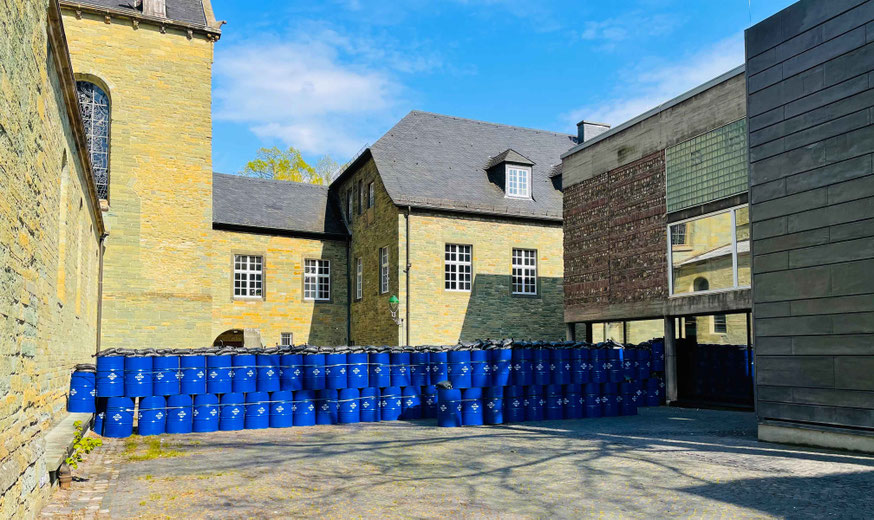
ZONE extends across the entire museum building, transforming it into a site of physical and perceptual division. At its center, a barrier of oil barrels cuts through the architecture, separating the exhibition into two inaccessible halves. Visitors are forced to reroute their movement, entering each section from different points, experiencing the space as fragmented and discontinuous.
The installation draws on the Green Line in Cyprus—the UN-controlled buffer zone that has divided the island since 1974. Referencing its material language of oil barrels, sandbags, and improvised barricades, ZONE translates a distant geopolitical reality into an immediate spatial condition. What is typically encountered as image or information becomes a bodily experience of obstruction, detour, and separation.
By embedding this structure within the museum, ZONE disrupts the expectation of seamless navigation and neutral display. Instead, the institution itself becomes a staged environment in which division is not observed but enacted. The work exposes how borders operate not only as political markers but as systems that shape movement, perception, and social relations.
Rather than representing a specific conflict, ZONE reveals the broader mechanisms through which territories and the identities attached to them are constructed, maintained, and normalized. It invites viewers to reflect on how division is produced, how it is experienced, and how it persists within both physical and symbolic spaces.
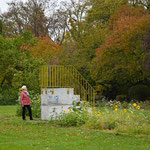
SPEAK FREE 2018

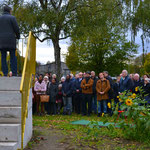
Speak Free is a permanent public installation in the city of Soest that translates the idea of free expression into a physical and spatial experience. Constructed from massive concrete, the work takes the form of an irregular staircase leading to an elevated platform—an imagined site from which to speak.
The structure resists ease and standardization. Its steps are deliberately uneven, built outside normative dimensions, making the ascent unstable and physically demanding. The heavy concrete base anchors the work in place, emphasizing permanence while simultaneously suggesting resistance and immobility. Reaching the top becomes an act of effort rather than a given right.
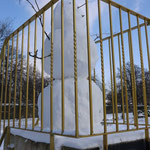
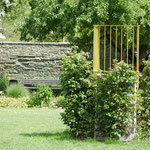
In contrast, a precisely installed golden handrail accompanies the climb. As the only element adhering to conventional standards, it introduces a symbolic layer: access, support, and visibility are not evenly distributed, but selectively structured. The color gold evokes value and privilege, pointing to the conditions under which voices are amplified, supported, or heard.
Rather than presenting free speech as an abstract principle, Speak Free stages it as a constructed and unequal terrain. The work exposes how the ability to speak and to be heard is shaped by physical, social, and political frameworks. It invites viewers to reflect on the effort, support, and positioning required to claim a public voice.